The Odyssey Book vs Movie
Matt Damon has a beard, Zendaya is a goddess, and Homer is somewhere in the afterlife either nodding along or throwing a lightning bolt. Here’s everything Christopher Nolan changed – and why it actually works.
So, Nolan Finally Made His Monster Movie (Sort Of)
For a guy who’s blown up buildings in real time, folded cities in on themselves, and made a three-hour movie about a man inventing the thing that could end the world, adapting a 2,700-year-old poem about a guy who really, really wants to go home sounds almost… relaxing. It is not relaxing. It’s a $250 million, IMAX-shot, seven-country fantasy epic starring basically everyone in Hollywood, and it has finally answered the question nobody asked but everybody wanted resolved: what happens when the director of Inception meets the original master of the nonlinear flashback?
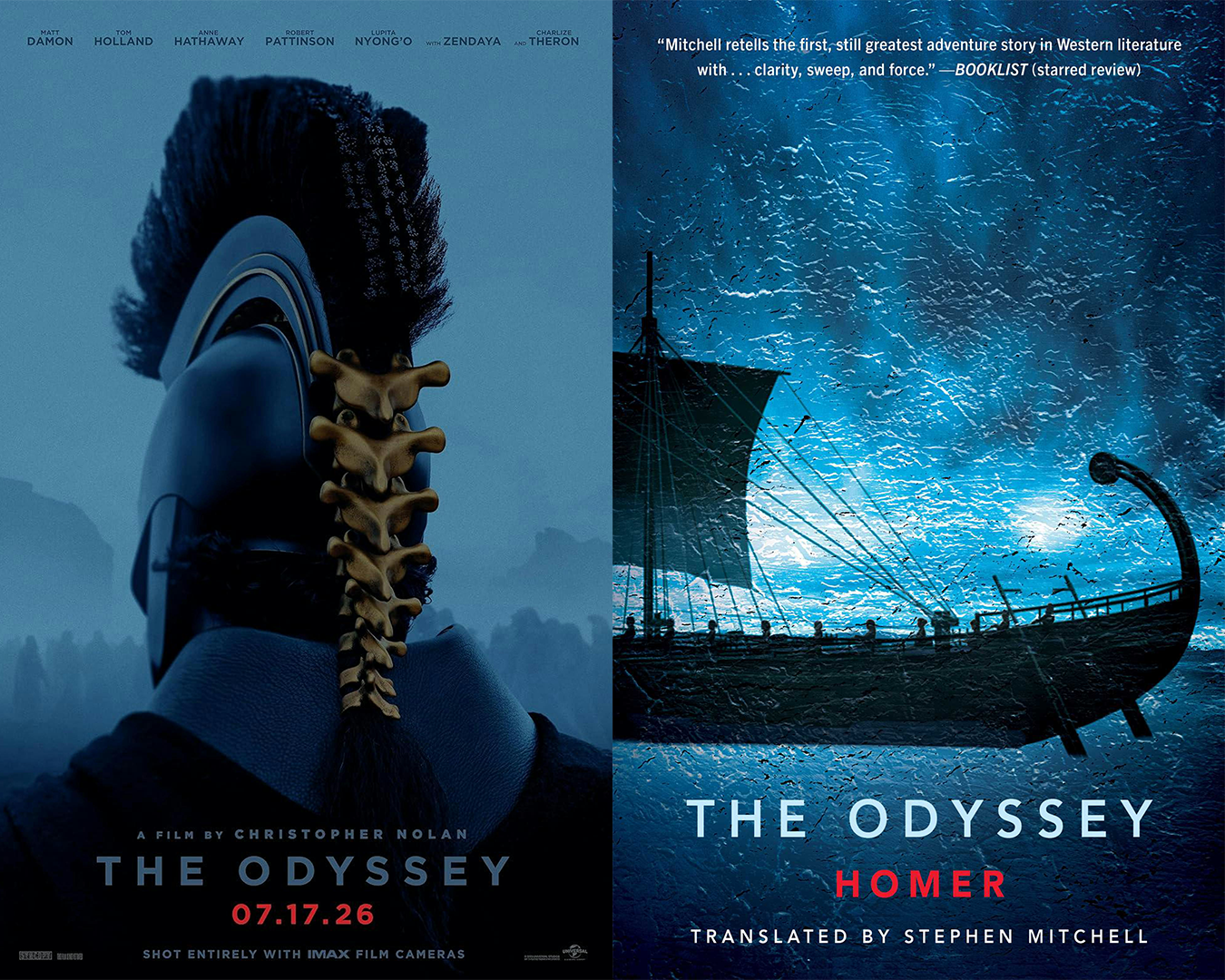
Christopher Nolan’s The Odyssey, starring Matt Damon as Odysseus, Tom Holland as Telemachus, Anne Hathaway as Penelope, Zendaya as Athena, Samantha Morton as Circe, Robert Pattinson as Antinous, and Lupita Nyong’o pulling double duty as Helen of Troy and Clytemnestra, hit theaters on July 17, 2026. And like every adaptation of a book people actually studied in school, it has already sparked the internet’s favorite pastime: gleefully cataloguing everything the movie “got wrong.”
Except here’s the twist, most of what Nolan changed isn’t a mistake. It’s a choice. And some of those choices are genuinely fascinating. Let’s break down where the movie and the poem part ways, why it matters, and whether Homer would have signed off on any of it.
1. The Gods Got a Demotion (Sort Of)
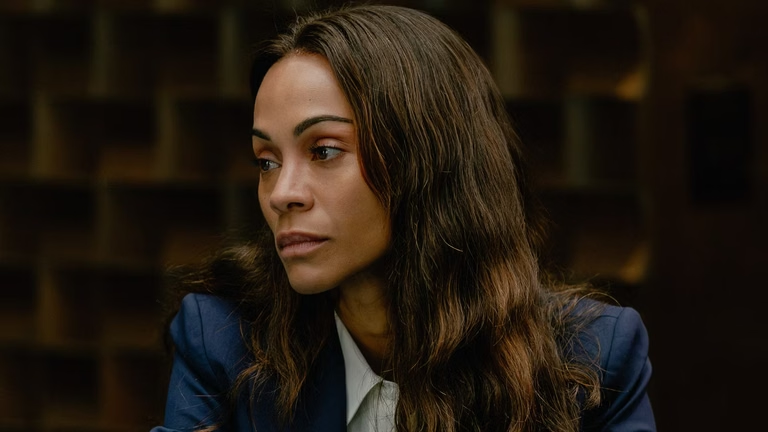
In Homer’s version, the gods are basically reality TV producers with lightning bolts, constantly interfering, throwing tantrums, and rigging outcomes for their favorite mortals. Nolan, ever the guy who likes his fantasy grounded in something resembling physics, dials that down considerably. Only Athena is given a physical form and appears to Odysseus in visions, while the other gods are presented mainly as forces of nature.
It’s a smart move for a director allergic to anything that smells like a superhero movie, but it does raise a question fans can’t stop poking at: is Zendaya’s Athena actually a goddess, or a very convincing hallucination? There’s real ambiguity in the film about whether Athena is genuinely appearing to Odysseus throughout the story, or whether she might be a manifestation in his head tied to guilt over someone he lost. Homer never had this problem. Homer’s gods showed up, meddled, and left. Nolan’s gods showed up and immediately made everyone question their sanity. Very on-brand.
2. Telemachus and Penelope Swap Personalities
This is the change that’s generating the most discourse, and honestly, it’s earned it. In the poem, Telemachus is… kind of a lot. He repeatedly condescends to his own mother, at one point ordering her back to her chambers and declaring that speech is the business of men. It’s a very Bronze Age take on family dynamics, and modern audiences tend to wince through it.
Nolan flips the script entirely. In the film, it’s Penelope who spends much of the runtime scolding her son for his immaturity, at one point even saying she’d happily watch the suitors burn. Anne Hathaway playing a queen who is done, completely done, with everyone’s nonsense is, frankly, casting perfection. Somewhere, 8th century BCE Homer is either turning in his grave or quietly impressed that someone finally gave Penelope the spine the poem kept implying she had.
3. Father and Son Reunite Earlier (and Differently)
Homer’s Telemachus is a resourceful guy who dodges the suitors on his own and stumbles into his father almost by coincidence at a swineherd’s hut. Nolan isn’t about to let his two biggest stars, Damon and Holland, sit apart for half the movie, so he restructures the reunion entirely. Instead of a chance encounter, Odysseus actively rescues Telemachus from suitors lying in ambush at a temple, and conceals his identity from his son a while longer than in the poem.
The recognition itself gets a gut-punch upgrade too: Telemachus only realizes the disguised beggar is really his father when Odysseus’s old hunting dog, Argos, finally dies at the sight of him. In the book, Argos’s death is a small, devastating detail buried in the text. In the movie, it’s apparently doing double duty as an emotional gut-check and a plot device. Efficient. Slightly cruel. Very Nolan.
4. No More Seven-Year Vacation With Calypso
In Homer, Calypso keeps Odysseus on her island for seven years, largely because she’s in love with him and let’s be honest, he doesn’t try that hard to leave. It’s one of those details modern readers side-eye pretty hard.
Nolan reworks the entire dynamic with a much darker mechanism. In the film, Odysseus doesn’t remember his journey home at all, because Calypso feeds him lotus flowers to erase his memories of Penelope, Telemachus, and Ithaca, partly to spare him from reliving his trauma, and partly because she wants him to stay with her forever. It’s less “extended romantic getaway” and more “psychological horror wrapped in a seduction plot,” which, again, tracks for the man who once made forgetting someone’s face the emotional climax of an entire film.
5. Whole Chunks of the Poem Just… Aren’t There
If you’re expecting a beat-for-beat translation of all 24 books, brace yourself. Nolan cuts the Telemachy, the poem’s opening four books following Telemachus’s own journey and Book 24 entirely, while keeping and even intensifying Homer’s flashback structure. The film also drops the Phaeacians and the underworld meeting with Achilles, and replaces Penelope’s famous bed test with a different device involving a war pin.
That flashback decision is arguably the film’s biggest structural gamble, and it’s also the one that seems to have paid off best. Critics have praised it directly: the film is described as unfolding in densely layered, nesting narratives, with flashbacks arriving as characters tell their own stories rather than in a straightened, chronological voyage with one prominent critic calling the braided structure “the most authentic thing” about the whole adaptation. Turns out the guy who made Memento backwards has some opinions about linear storytelling, and Homer, who told his own story out of order 2,700 years before nonlinear narrative was cool, would probably approve.
6. The Ending Is a Completely Different Animal
Buckle up, because this is where the movie goes fully off-book and it’s the choice everyone’s still arguing about.
How the poem ends: Odysseus strings his bow, slaughters the suitors, and Penelope tests him by asking him to move their marriage bed, a bed he famously built around a living olive tree, meaning it cannot be moved. Getting the answer right proves his identity, and the two reunite. Then the suitors’ grieving families show up for revenge, a fight breaks out, and Athena swoops in to magically force a truce so everyone can just… move on.
How the movie ends: The film ends on abdication and voluntary exile: Odysseus steps down, Telemachus is crowned king of Ithaca, and Odysseus sails west with Penelope as penance for the massacre in the hall. No divine intervention. No tidy truce. There’s no orchard reunion with his father Laertes, and no peace imposed by the gods, the film simply invents an ending Homer never wrote.
It’s a genuinely bold swap. Homer’s ending is messy, sudden, and honestly a little unsatisfying even on its own terms (scholars have debated the abruptness of Book 24 for centuries). Nolan’s version trades divine deus-ex-machina for something more like a Western hero riding into the sunset, minus the triumph. Rather than reading as weakness, Telemachus’s coronation is framed as Odysseus giving his son the freedom to build a new Ithaca unburdened by the cycle of violence and divine grudges that defined his own life. It’s less “and they all lived happily ever after” and more “and some of them left to go process their trauma abroad,” which, fair enough, feels very 2026.
7. A Bed Test Becomes a Pin
Small detail, big symbolism: the film swaps out Penelope’s iconic bed test for a war pin instead. The bed test worked in the poem because it relied on a secret only Odysseus could know, proof of identity through shared history. A pin does something slightly different: it’s an object, a keepsake, something that can be shown rather than known, which suits a visual medium a lot better than a riddle about furniture. Still, purists have noted it strips away one of the more quietly brilliant details in the entire poem, Penelope testing her husband’s honesty before testing his identity.
Why Any of This Actually Matters
Here’s the thing people conveniently forget in the “the movie ruined the book” discourse: the Odyssey was never one fixed text to begin with. It comes from an oral tradition that was expanded and reshaped over centuries before it was ever written down. Homer himself was working from, and altering, stories that already existed. Nolan changing the ending isn’t sacrilege. It’s the exact same tradition the poem was born from, just with a $250 million budget and Hoyte van Hoytema behind the camera instead of a guy with a lyre at a campfire.
That doesn’t mean every change lands perfectly, or that classicists won’t have feelings about the missing Telemachy and the vanished Phaeacians. But treating a millennia-old oral epic like sacred, unchangeable scripture kind of misses the entire point of what made it survive this long in the first place: it was always meant to be retold.
The Bottom Line
Nolan’s The Odyssey isn’t a translation. It’s an argument about memory, guilt, family, and what home actually means once you’ve done unspeakable things to get back to it. Homer gave us gods pulling strings and a hero getting rewarded with a happy homecoming. Nolan gives us a hero who isn’t sure he deserves one, a wife with significantly less patience for nothing, and a son who inherits a kingdom instead of a father.
Whether that’s a better ending than Homer’s is, appropriately enough, an argument that’s going to outlive all of us, same as the poem itself.
Have you seen The Odyssey yet? Let us know which change surprised you the most in the comments below.
About the Author