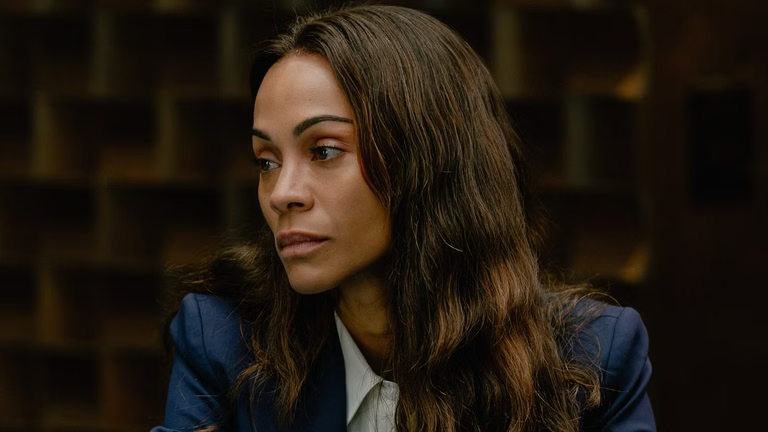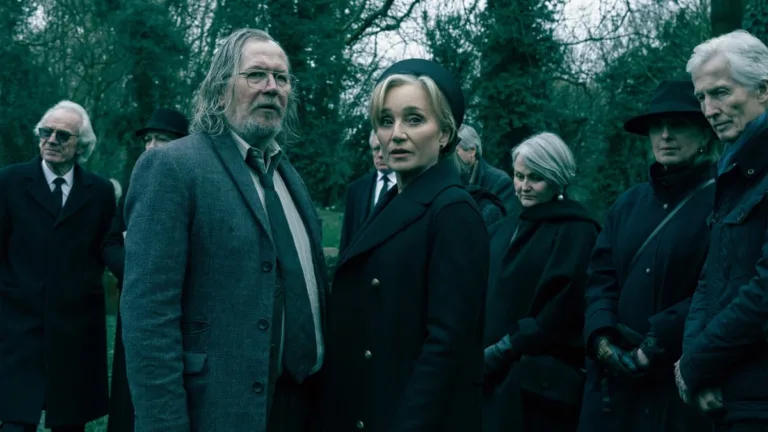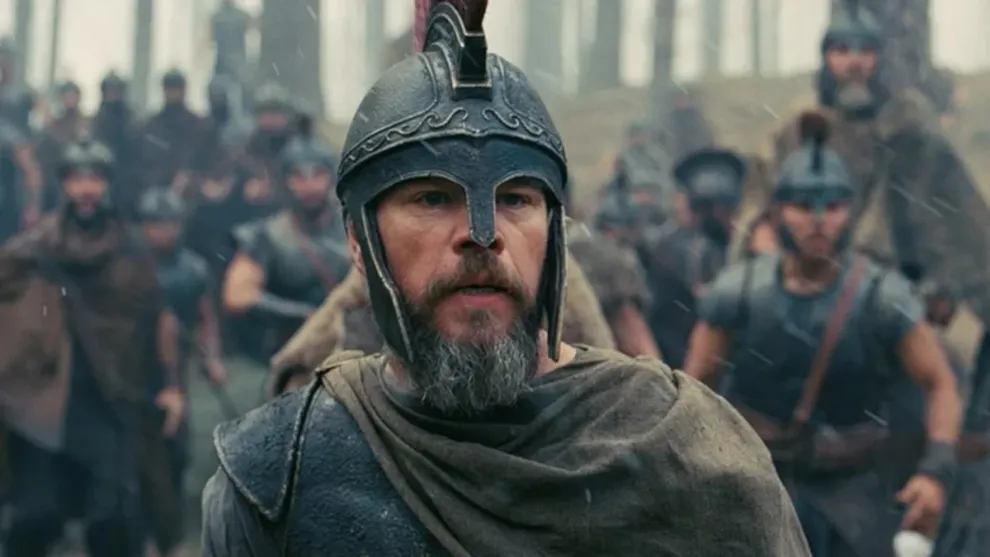
Matt Damon in 'The Odyssey' (Universal Pictures)
Christopher Nolan’s The Odyssey is finally in theaters, and after months of casting controversies, angry trailer comments, and enough online discourse to sink an actual Greek trireme, the reviews are in. The verdict? Wildly, gloriously split and honestly, that might be the most Nolan thing about it.
Let’s set the scene: nearly three hours, an all-star cast that reads like the group chat from every awards season party of the last decade, a script Nolan adapted himself, and a promise that this is his most “human” film since The Prestige. So does The Odyssey stick the landing after ten years lost at sea (fictionally) and about a year lost to internet arguments (very much in real life)? Let’s break it down.
The Story, Minus the Spoilers That Matter
You probably know the broad strokes even if you’ve never cracked open a copy of Homer: Odysseus (Matt Damon), King of Ithaca, has been gone twenty years, ten fighting in Troy, ten more wandering home through monsters, gods, and increasingly bad decisions. Back home, his wife Penelope (Anne Hathaway) is fending off a small army of freeloading suitors, while his son Telemachus (Tom Holland), now fully grown, insists his father is still alive somewhere out there.
Nolan structures the whole thing the way he structures everything: time bent, folded, and reshuffled until past and present sit at the same table. If you’ve seen Oppenheimer, you know the drill: nothing here happens in a straight line, and that’s very much the point.
The Reviews That Loved It (A Lot of Them, Loudly)
The overwhelming early consensus leans triumphant. Critics have described the film as one of Nolan’s finest achievements, with several ranking it right up there with Dunkirk and Interstellar in terms of sheer craft. One reviewer went as far as comparing it to Nolan finally making his own version of a David Lean-style epic, think Lawrence of Arabia, but with more sea monsters and fewer camels.
The praise clusters around a few things in particular:
- The cast is absurdly stacked, and everyone shows up. Tom Holland is getting some of the best notices of his career playing Telemachus, and more than one critic singled out Robert Pattinson as a scene-stealer. Samantha Morton, despite limited screen time, reportedly walks away with entire scenes.
- It’s unexpectedly emotional. Multiple critics have called this Nolan’s most humanistic film yet, arguing it foregrounds character and feeling in a way his more puzzle-box movies (looking at you, Tenet) never quite bothered to.
- It’s genuinely massive in scope, shot across Italy, Greece, Morocco, Iceland, and Scotland, and presented in IMAX with a scale several critics have called the biggest of Nolan’s career which, for the director of Interstellar and Dunkirk, is really saying something.
- There’s a horror sequence. Yes, really. Apparently this is new territory for Nolan, and early reactions suggest it’s one of the film’s most talked-about surprises.
The Reviews That… Did Not Love It
And then there’s the other camp, which is considerably less starstruck. The most pointed criticism argues the film is technically dazzling but strangely hollow gorgeous landscapes that somehow fail to feel lived-in, and emotional beats (including one involving Odysseus’s elderly dog) that land with mechanical precision rather than actual feeling. This critique lands its sharpest blow on pacing: for a story overflowing with incident, cramming everything in may have been the wrong call, when a more selective, focused approach might have let a few moments truly breathe.
There’s also a recurring complaint that Lupita Nyong’o, playing a dual role as Helen and Clytemnestra, doesn’t get nearly enough to do given her talent a criticism that stings a little more given how much of the pre-release discourse centered on her casting in the first place.
So… Is It Good?
Here’s the honestly-kind-of-fun answer: it depends entirely on what you want from Nolan. If you’re here for the big swings the scale, the score, the “how did they even film that” set pieces the consensus says you’re going to have an incredible time, possibly twice, since more than one critic has already mentioned it gets better on a second viewing. If you’re here hoping for the emotional interiority of something like The Return (the smaller, quieter 2025 take on this same myth), you might walk away feeling like all that spectacle came at the cost of intimacy.
Either way, nobody’s calling this a boring movie. “Muddy melodrama” and “career-best” are both circulating in the same news cycle, which tells you everything about how ambitious a swing this actually was.
The Bottom Line
After a year of casting outrage, trailer discourse, and a hundred think-pieces about whether Nolan should have made this movie at all, The Odyssey has arrived and mostly done what Nolan movies do: split the room while filling the theater. The consensus, if there is one, seems to be that this is unmistakably a massive, ambitious, unmistakably Nolan film love it or find it a little cold, you won’t forget you watched it.
About the Author